Before this article gets underway, let me just say I
understand this will probably incite some heated and passionate
responses. Keep it clean and try to avoid the tired 'Cena sucks'
response. I look forward to any comments and any feedback you are
willing to give.
The Raw opening has aired and the fireworks have been set off. The
crowd is waiting in silent anticipation of the night's first act. Then,
without warning, his entrance music explodes over the PA system and the
WWE Universe erupts. The majority cheer the impending appearance of
their favorite Superstar while others, mainly members of the
ever-valuable 18-to-35 demographic, can be heard jeering him. Like a
bullet ejected from the chamber of a nine millimeter, he shoots through
the curtain and out onto the stage. He salutes the fans and takes off on
a sprint towards the ring. The excitement in the arena is at a fever
pitch. He is adored by many across the globe and despised nearly as much
by others.
He is
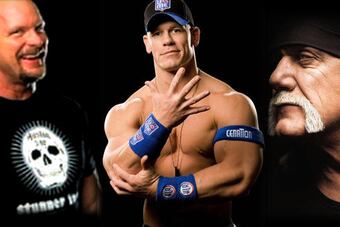
John Cena and like it or not, he is the best wrestler in the world.
There is a common misconception made regularly by fans across the
internet. The term "best wrestler in the world" is often applied to
outstanding in-ring workers such as the current United States Champion
Daniel Bryan, the currently-on-hiatus Chris Jericho, or any number of
performers employed by Total Nontop Action, Ring of Honor, or Dragon
Gate. While these athletes deserves accolades for their in-ring
performances, none can convincingly lay claim to being the best wrestler
on the planet.
Often times, largely within the internet fan base, it is forgotten
that professional wrestling is so much more than the display of
technical prowess, the use of submission holds discovered in MMA camps
and forty-five variations of the suplex. It incorporates the interviews
leading to the matches, the marketing done to promote the events, and
the outside media projects that allow the performers to gain more
exposure and, as a result, help the company grow.
In reality, despite what many may believe, the in-ring product is but
a small fraction of what makes a wrestler the best in the world at what
he does.
The most common of criticisms regarding John Cena is his apparent
lack of wrestling skills. Some even say he wouldn't know the difference
between a wist lock and a wrist watch. Those same critics have clearly
forgotten the the wrestling "masterpieces" engaged in by the likes of
The Rock, Stone Cold Steve Austin,
Hulk Hogan,
and Mick Foley. All four men were lacking in wrestling ability. The
main event matches they appeared in were either brawls or punch and kick
affairs with little or no sign of actual wrestling ability. Their best
matches were often the ones in which their opponents had a more varied
skills set.
Cena on the other hand, has proven his ability to have very good, or
in some cases great matches with a variety of different performers. The
matches he had with the likes of Shawn Michaels, Triple H,
Randy Orton
and Edge were as good as expected and are fondly remembered today. But
good matches with Superstars like those four proves nothing. It is
Cena's early-to-mid 2007 string of matches that serves as evidence of
his greatness inside the ropes.
The majority of 2007 was interesting for WWE. With major injuries
sidelining mega-stars such as Triple H, Edge, Rey Mysterio, Shawn
Michaels and the Undertaker for significant periods of the year, Cena
was trusted to carry the company on his shoulders. The question was, who
was left to challenge him for the championship?
The answer would come in the form of two very green newcomers and a
veteran in-ring performer who had yet to fully get over as the monster
heel he had been positioned as. Rather than share the ring with
established, veteran ring generals like Triple H, Shawn Michaels and
Edge, Cena was forced into matches with the likes of Umaga, the Great
Khali and Bobby Lashley. To this day, Cena's matches with these men
remain, individually, the best matches of their careers. As a matter of
fact, many consider the Last Man Standing match with Umaga at the 2007
Royal Rumble pay-per-view one of the best in the historic event's
history, as well as the only major competition to the Cena-Michaels
series for match of the year.
A year later, Cena had a phenomenal match with Batista despite
suffering from a neck injury. In 2006, Cena had what can be surprised as
the single greatest performance of his career as he defended the WWE
Championship in a very good, Attitude Era-esque match against Rob Van
Dam in front of a bloody-thirsty, riot-threatening pack of ECW fans in
New York. John Cena's abilities to get the very most out of a lesser
quality opponent or a hostile environment is just a sample of what makes
him the phenomenal performer he has become. He is a craftsman and
artist that has mastered a formula that has catapulted Rock, Austin,
Hart, Michaels and Hogan to the top of the industry.

John Cena learned a long time ago to camouflage his weaknesses to the
point that you could not see them and then accentuate his positives. He
is a believable face who can create sympathy when he is on the
receiving end of a beat down and excitement when he finally makes his
Herculean comeback. And for the critics complaining about his aura of
invincibility, that he always manages an explosive comeback no matter
who or how many have beaten on him throughout the match, there are
several well-known, highly-decorated Superstars who established
themselves and made a career out of following this tried and true
formula.
Hulk Hogan, Bret Hart, Shawn Michaels, Stone Cold Steve Austin, and
The Rock have all played the role of "main event baby face who overcomes
the odds to emerge victorious." From Hogan single-handedly defeating
the Big Bossman and Akeem after his tag team partner abandoned him, to
Shawn Michaels and Bret Hart withstanding a major beating from and
ultimately defeating wrestlers much larger than them, to Stone Cold and
The Rock tearing through the members of the dastardly Mr. McMahon's
Corporation, all five legends in the professional wrestling world have
achieved the level of success they have because of the same formula Cena
utilizes today.
These men used the formula to their benefit, telling a story the fans
could understand and willingly bought into and invested themselves in.
The heel worked the face over before the ultimate good guy stormed back
with a series of signature move set before the finishing move sent the
fans home happy. These men stayed at the top of their craft until there
was a new star ready to take their place. John Cena finds himself in
that spot, telling the same story. Whether the formula is flawed is an
entirely separate argument for an entirely separate article. But it is
both insane and irresponsible to put the blame of a tired formula at the
feet of one man.
Luckily for Cena, he is not left to the mercy of the formula. His
out-of-ring presence has led him to become perhaps the most immediately
recognizable star the business has left.
It is nearly impossible to flip through any of the hundreds of
channels provided by your cable company without seeing John Cena's
image. Whether it be a pay-per-view event spot, a Gillette razor
commercial, a Mattel action figure ad or the re-airing of any of his
three WWE Studios films, Cena is everywhere.
He has graced hundreds of magazine, video game, and DVD covers. He is
the face of Topps' WWE trading card line. He has played guest analyst
on ESPN's Sports Center, College Football Live, First Take and Sports
Nation. He's been invited to several major sporting events and served as
the grand Marshall of the 2010 Fiesta Bowl between Boise State and TCU.
Cena's continued presence in multiple forms of media has allowed the
outside world to familiarize themselves not only with Cena himself but
also with his employers, the WWE. His real life superhero/G.I. Joe looks
and his rather wholesome appearance allows parents to trust that he is a
positive role model for their children.
John Cena has become an idol to fans across the globe. Much like
Superman or Batman or any other DC or Marvel comic book superhero, Cena
teaches kids that if you stick to your morals and work hard, you can and
will succeed regardless of any obstacles or road blocks put in your
path. He is the pure good guy that any fan can relate to. He beats up
the bad guys and does not back away from a fight.
For the two or three hours he is on the screen every week, fans can
forget whatever else is going on in their lives and escape reality. They
can cheer Cena because his character is a symbol of hope that no
obstacle is insurmountable. It is a character as simple as Cena's that
is why we became wrestling fans in the first place.
It remains unknown whether or not Cena will drive in the ratings, the
pay-per-view buys or revenue that his predecessors did. Where Cena
takes his place among the all-time greats is also unknown. What is known
is that Cena's greatness cannot be measured by the flawed system
employed by the majority of smart marks populating the internet. It is
about the culmination of every facet of the industry into one complete
package.
Hulk Hogan was that package in the 1980's and Stone Cold Steve Austin
and The Rock in the 1990's. John Cena is the greatest wrestler in the
world today because he goes above and beyond the call of simply
performing night in and night out inside the ring. He is an ambassador
for the sport, and one day, when Cena is no longer performing for the
WWE fans, each and every one of those who took the time to sit back and
appreciate his work will respect him for his greatness and the legacy he
left behind.