
After WWE Champion CM Punk rejected John Cena’s challenge to meet a Hell in a Cell, the Cenation leader unloaded on the champion with a lead pipe! Following the stunning assault, Punk took out his frustration on Mick Foley. See which Superstar left Punk speechless after his backstage attack.
check it out how your superstar is rated among the strongest man in wwe
Replacement referees don’t belong in the NFL … or WWE

On the final play of "Monday Night Football," with only eight seconds on the clock and the Seattle Seahawks trailing the Green Bay Packers, 12-7, Seahawks quarterback Russell Wilson chucked a 24-yard Hail Mary pass into a free-for-all in the end zone. Wide receiver Golden Tate shoved a defender in the back with both hands, eliminating an opponent to fight him for the ball while creating the possibility of a clear path to it as well.
Tate and Green Bay safety M.D. Jennings then both got their hands on the ball, though the Packers and almost everyone watching the game, insisted Jennings had clear possession for a game-ending interception.
Instead, after conflicting signals from two officials, the replacement referees ruled on the field that Tate and Jennings had simultaneous possession, which counts as a reception and a win for Seattle (a situation almost identical to the double pinfall of WWE Champion CM Punk and John Cena that occurred at Night of Champions). to his credit, seasoned WWE official Chad Patton made the right call as he has thousands of times throughout his 10 years with WWE.
Conversely, the following night on Raw, a referee that would have remained anonymous had he not blown a call in the tag team main event, counted CM Punk’s shoulders to the mat, not seeing that Punk had managed to drape his foot across the bottom rope before the count of three, enraging the WWE Champion.
John Cena's Elbow Surgery: A Breakdown of the Injury and Procedure (by cena william)
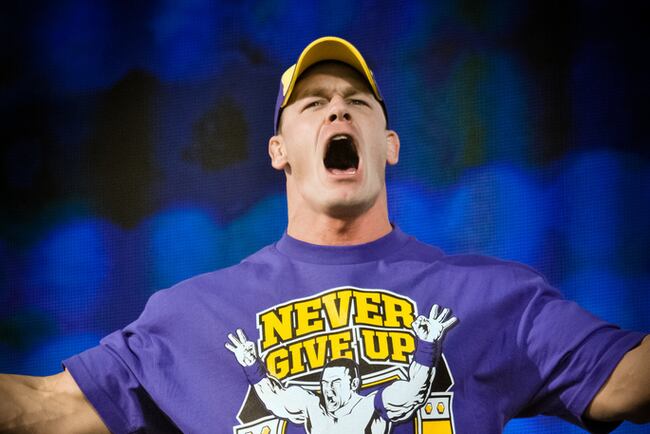 Photo by Reckless Dream Photography
WWE mainstay and megastar John Cena won't be around to deliver his Five Knuckle Shuffle for a while as he recovers from elbow surgery.
Most WWE fans have already heard the news of his injury, but some may not understand what was wrong with him in the first place. The question of when he returns is a significant one, as he is in the midst of a feud with WWE Champion CM Punk.
There has been some debate about how long he will be out of action. WWE.com originally put his recovery time at two to three weeks.
John Cena tweeted otherwise:
With any kind of post-surgery recovery, even the best estimates are still just estimates. Understanding the extent of Cena's injury and the procedure he went through can give us a clearer picture than conjecture.
The Injury
The grueling nature of pro wrestling catches up with every wrestler in the end. Night after night of getting thrown around the ring took its toll on Cena's elbow.
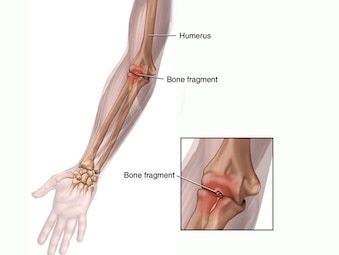 photo from summitmedicalgroup.com
Fragments of the bone had begun to chip and roam around loose in his arm. This is known as osteochondritis dissecans.
photo from summitmedicalgroup.com
Fragments of the bone had begun to chip and roam around loose in his arm. This is known as osteochondritis dissecans.
Summitmedicalgroup.com states that osteochondritis dissecans "is a disorder in which fragments of bone or cartilage come loose and float around in the elbow joint."
Physical trauma over time, something that WWE stars endure daily, can cause this type of fragmentation.
Osteochondritis dissecans is often seen in baseball players. The stress of throwing a baseball multiple times can lead to this injury as well.
Major league pitchers Johan Santana and Drew Storen, among others, have had to get bone chips removed from their elbow.
John Cena was wrestling just a day before his surgery. He was in the Night of Champions main event just two nights before the procedure.
News of Cena's injury and surgery came as a surprise because the effects weren't obvious to those watching him perform in the ring.
While a starting pitcher's lowered velocity is obvious to fans, Cena could still do his job, just uncomfortably. The Summit Medical Group website says this type of injury may cause the elbow to swell and "you may not be able to completely straighten your arm."
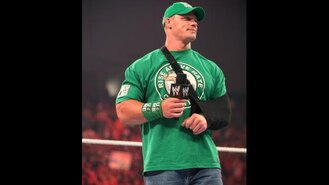 photo from wwe.com
The Surgery
Dr. James Andrews performed arthroscopic surgery on Cena's elbow on Tuesday, Sept. 18. Dr. Andrews is famous in the sports world for performing major surgeries on players like Drew Brees, Peyton Manning and Michael Jordan.
Cena fans can rest easy knowing that he was in experienced, expert hands.
The goal of surgery in this situation is to remove the damaged structures. A tiny camera is inserted into the injured joint which allows the surgeon to work in the small, cramped area.
Cleaning out the debris is sometimes referred to as "scoping" the elbow. The minimally invasive nature of the procedure is designed to limit scarring and speed up recovery time.
That's good news for the Cenation.
The Los Angeles Times quotes Dr. Andrews as saying, "I performed an arthroscopic procedure on his elbow and took out a bunch of spurs. Everything went really well."
The first step was successful; now comes the hard part for WWE bookers and Cena fans, the waiting.
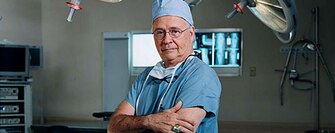 Dr. James Andrews (photo from fangraph.com)
The Recovery
The question on everyone's mind is "will John Cena be ready to perform at Hell in a Cell on Oct. 28?"
Going by the timetable that Cena tweeted, he won't be ready to go until two days after the pay-per-view.
After Washington Nationals pitcher Drew Storen underwent the same surgery on April 11, he didn't pitch in a simulated game until July 3. That's nearly three months.
Unlike Cena, he was allowed to ease back in.
Baseball is clearly not the same as wrestling, just as Storen's elbow is not Cena's. Still, it's clear that this is a major procedure that requires significant recovery time.
Clevelandclinic.com discusses recovery after arthroscopic elbow surgery:
He is too big of a star and they are too dependent on him to take the patient route. While that may be beneficial for Cena's long-term health, he will likely be in the ring as soon as he is able to lift a man over his shoulders,
Cena is famous for his work ethic in the gym and should recover faster than the average patient. Still, it's unlikely that Cena will be fully healthy by Hell in a Cell.
Dr. Andrews' statement about "a bunch of spurs" leads one to think recovery time will be longer than the minimum.
It's more profitable for WWE to showcase a Cena who is not at full strength than to keep him out of the ring for as long he should be. He is the biggest star in a sport where stars are vital.
Rushing Cena back, however, can worsen the injury and cause long-term damage. Vince McMahon and WWE have a big decision to make.
 After just over seven months, Chris Jericho
is once again gone from WWE to resume his music career on tour with
Fozzy. Let's take a look at what he accomplished and left behind during
his latest run.
After just over seven months, Chris Jericho
is once again gone from WWE to resume his music career on tour with
Fozzy. Let's take a look at what he accomplished and left behind during
his latest run.
Prior to his return on January 2, 2012, a series of cryptic videos involving children in a classroom setting and playing with a ball, writing in a notebook—among other things—were seen. These were purposely ambiguous and generated a lot of hype.
Jericho finally returned on the first RAW in the new year, revealed as the man who will bring forth "the end of the world as we know it." Much like his previous returns, this one was different. For weeks, he didn't speak; Jeri-Troll was leading on the WWE Universe, leaving them wanting more. Without saying a word, he turned himself into a heel.
Finally, just before the Royal Rumble, Jericho spoke, and participated in the Rumble. I thought at the time that, much like his silence and his refusal to participate physically in anything up until that time, we could possibly see Jericho win the Rumble without lifting a finger.
Instead, looking back, we saw something better—an excellent back-and-forth battle between Jericho and Sheamus, which saw Sheamus win and go on to become World Heavyweight Champion. A part of that success can be credited to Jericho and the way Sheamus was able to win the Royal Rumble.
Jericho turned his attention to CM Punk, calling him out for using the "Best in the World" catchphrase. After failing to win the WWE title at Elimination Chamber (but not "losing" in the match), Jericho became the No. 1 contender and faced CM Punk at WrestleMania.
Their lead up, which involved an alcohol storyline involving Punk's family, saw a WWE title match at WrestleMania, in a terrific 22-minute match on the second-to-last match of the night. Leading up to these matches, Jericho saw a lot of show time with Kofi Kingston, who Jericho praised numerous times on Twitter.
Jericho continued with Punk through Extreme Rules, which was in Punk's hometown. Jericho lost a Chicago Street Fight, putting Punk at 2-0 against Jericho in big match scenarios in 2012.
A Fatal Four-Way was next for Jericho at Over The Limit with Sheamus, Alberto Del Rio and Randy Orton. It ended with Jericho being pinned by Sheamus for the win.
A blip on the road came on May 24 at a live event in Brazil, when Jericho kicked the Brazilian flag out of the ring and was forced to apologize for the incident and was suspended for 30 days as a result.
Upon his return, he saw himself in the ring with John Cena, a man he met in pay-per-view main events in 2005. Both entered a Money in the Bank match involving former champions, which Cena eventually won.
The following night on RAW, Jericho found himself in the ring with Dolph Ziggler, turning face again, much like the beginning of his run, with no words, a simple code breaker and the crowd cheering on "Y2J" once again. After a back and forth (including Jericho bringing back his "nicknames," at least on Tout, calling his opponent "Dolph Zoggler"), Jericho claimed his first PPV win of his return—as it happens, the day before he leaves.
The next day, on RAW, Ziggler defeated Jericho, and just like that Y2J was gone for another extended period of time. On Twitter, Jericho said this won't be the last you see of him.
So what did we learn from his latest stint? It's simple: Jericho is such an established name and is so "untouchable" as a marketable entity that he can barely win matches and still maintain the perception that he is important, and should be treated as a main eventer.
In short, during his last run, he helped Sheamus get over as a main eventer, further Punk's star status at WrestleMania, had great matches with Kofi Kingston on TV and at live events, took big bumps in a Money in the Bank ladder match, and elevated Dolph Ziggler.
That sounds like an impressive, successful and unselfish run to me. So long, Chris Jericho, and we will welcome you with open arms when you choose to return.
Most WWE fans have already heard the news of his injury, but some may not understand what was wrong with him in the first place. The question of when he returns is a significant one, as he is in the midst of a feud with WWE Champion CM Punk.
There has been some debate about how long he will be out of action. WWE.com originally put his recovery time at two to three weeks.
John Cena tweeted otherwise:

With any kind of post-surgery recovery, even the best estimates are still just estimates. Understanding the extent of Cena's injury and the procedure he went through can give us a clearer picture than conjecture.
The Injury
The grueling nature of pro wrestling catches up with every wrestler in the end. Night after night of getting thrown around the ring took its toll on Cena's elbow.
photo from summitmedicalgroup.com
Summitmedicalgroup.com states that osteochondritis dissecans "is a disorder in which fragments of bone or cartilage come loose and float around in the elbow joint."
Physical trauma over time, something that WWE stars endure daily, can cause this type of fragmentation.
Osteochondritis dissecans is often seen in baseball players. The stress of throwing a baseball multiple times can lead to this injury as well.
Major league pitchers Johan Santana and Drew Storen, among others, have had to get bone chips removed from their elbow.
John Cena was wrestling just a day before his surgery. He was in the Night of Champions main event just two nights before the procedure.
News of Cena's injury and surgery came as a surprise because the effects weren't obvious to those watching him perform in the ring.
While a starting pitcher's lowered velocity is obvious to fans, Cena could still do his job, just uncomfortably. The Summit Medical Group website says this type of injury may cause the elbow to swell and "you may not be able to completely straighten your arm."
photo from wwe.com
As tough he is, eventually the injury would have made it too painful for him to perform. Surgery was inevitable.
Dr. James Andrews performed arthroscopic surgery on Cena's elbow on Tuesday, Sept. 18. Dr. Andrews is famous in the sports world for performing major surgeries on players like Drew Brees, Peyton Manning and Michael Jordan.
Cena fans can rest easy knowing that he was in experienced, expert hands.
The goal of surgery in this situation is to remove the damaged structures. A tiny camera is inserted into the injured joint which allows the surgeon to work in the small, cramped area.
Cleaning out the debris is sometimes referred to as "scoping" the elbow. The minimally invasive nature of the procedure is designed to limit scarring and speed up recovery time.
That's good news for the Cenation.
The Los Angeles Times quotes Dr. Andrews as saying, "I performed an arthroscopic procedure on his elbow and took out a bunch of spurs. Everything went really well."
The first step was successful; now comes the hard part for WWE bookers and Cena fans, the waiting.
Dr. James Andrews (photo from fangraph.com)
The Recovery
The question on everyone's mind is "will John Cena be ready to perform at Hell in a Cell on Oct. 28?"
Going by the timetable that Cena tweeted, he won't be ready to go until two days after the pay-per-view.
After Washington Nationals pitcher Drew Storen underwent the same surgery on April 11, he didn't pitch in a simulated game until July 3. That's nearly three months.
Unlike Cena, he was allowed to ease back in.
Baseball is clearly not the same as wrestling, just as Storen's elbow is not Cena's. Still, it's clear that this is a major procedure that requires significant recovery time.
Clevelandclinic.com discusses recovery after arthroscopic elbow surgery:
Recovery varies from one week to several months, depending on the extent of the surgery. Most patients can return to heavy work and sports within three to six weeks of surgery if the procedure is minor. However, three to six months is often required for complete recovery.There is no way WWE is going to let Cena rest for three to six months.
He is too big of a star and they are too dependent on him to take the patient route. While that may be beneficial for Cena's long-term health, he will likely be in the ring as soon as he is able to lift a man over his shoulders,
Dr. Andrews' statement about "a bunch of spurs" leads one to think recovery time will be longer than the minimum.
It's more profitable for WWE to showcase a Cena who is not at full strength than to keep him out of the ring for as long he should be. He is the biggest star in a sport where stars are vital.
Rushing Cena back, however, can worsen the injury and cause long-term damage. Vince McMahon and WWE have a big decision to make.
WWE Analysis: Grading Chris Jericho's Latest WWE Run

Prior to his return on January 2, 2012, a series of cryptic videos involving children in a classroom setting and playing with a ball, writing in a notebook—among other things—were seen. These were purposely ambiguous and generated a lot of hype.
Jericho finally returned on the first RAW in the new year, revealed as the man who will bring forth "the end of the world as we know it." Much like his previous returns, this one was different. For weeks, he didn't speak; Jeri-Troll was leading on the WWE Universe, leaving them wanting more. Without saying a word, he turned himself into a heel.
Finally, just before the Royal Rumble, Jericho spoke, and participated in the Rumble. I thought at the time that, much like his silence and his refusal to participate physically in anything up until that time, we could possibly see Jericho win the Rumble without lifting a finger.
Instead, looking back, we saw something better—an excellent back-and-forth battle between Jericho and Sheamus, which saw Sheamus win and go on to become World Heavyweight Champion. A part of that success can be credited to Jericho and the way Sheamus was able to win the Royal Rumble.
Jericho turned his attention to CM Punk, calling him out for using the "Best in the World" catchphrase. After failing to win the WWE title at Elimination Chamber (but not "losing" in the match), Jericho became the No. 1 contender and faced CM Punk at WrestleMania.
Their lead up, which involved an alcohol storyline involving Punk's family, saw a WWE title match at WrestleMania, in a terrific 22-minute match on the second-to-last match of the night. Leading up to these matches, Jericho saw a lot of show time with Kofi Kingston, who Jericho praised numerous times on Twitter.
Jericho continued with Punk through Extreme Rules, which was in Punk's hometown. Jericho lost a Chicago Street Fight, putting Punk at 2-0 against Jericho in big match scenarios in 2012.
A Fatal Four-Way was next for Jericho at Over The Limit with Sheamus, Alberto Del Rio and Randy Orton. It ended with Jericho being pinned by Sheamus for the win.
A blip on the road came on May 24 at a live event in Brazil, when Jericho kicked the Brazilian flag out of the ring and was forced to apologize for the incident and was suspended for 30 days as a result.
Upon his return, he saw himself in the ring with John Cena, a man he met in pay-per-view main events in 2005. Both entered a Money in the Bank match involving former champions, which Cena eventually won.
The following night on RAW, Jericho found himself in the ring with Dolph Ziggler, turning face again, much like the beginning of his run, with no words, a simple code breaker and the crowd cheering on "Y2J" once again. After a back and forth (including Jericho bringing back his "nicknames," at least on Tout, calling his opponent "Dolph Zoggler"), Jericho claimed his first PPV win of his return—as it happens, the day before he leaves.
The next day, on RAW, Ziggler defeated Jericho, and just like that Y2J was gone for another extended period of time. On Twitter, Jericho said this won't be the last you see of him.
So what did we learn from his latest stint? It's simple: Jericho is such an established name and is so "untouchable" as a marketable entity that he can barely win matches and still maintain the perception that he is important, and should be treated as a main eventer.
In short, during his last run, he helped Sheamus get over as a main eventer, further Punk's star status at WrestleMania, had great matches with Kofi Kingston on TV and at live events, took big bumps in a Money in the Bank ladder match, and elevated Dolph Ziggler.
That sounds like an impressive, successful and unselfish run to me. So long, Chris Jericho, and we will welcome you with open arms when you choose to return.
IS JOHN CENA THE REASON WHY WWE Monday Night Raw scored its lowest viewership in 2012.
For the second straight week the show had under 4
million viewers. The first hour began weakly with 3.43 million viewers.
Its second hour was its high point with 3.59 million viewers tuning in.
Raw's third hour dropped to 3.47 million viewers.
In Adults 18-49, Raw peaked at a 1.3 rating share during its final hour. The first and second hours notched a 1.2 rating share.
Monday Night Football
dominated cable television viewership, with the game between the Dallas
Cowboys and Chicago Bears pulling in 16.6 million viewers. Monday Night Football also had a 6.8 rating share in Adults 18-49, making it the No. 1 show on cable television.
My quick take on WWE Monday Night Raw viewership:
Ouch!
Another sack taken by the WWE, this time scoring its worst viewership in 2012. WWE officials should be alarmed at the recent viewership trends happening to Monday Night Raw.
Raw's
biggest issue is that the three-hour format has failed thus far. It is
just simply too long of a show to have viewers tune in throughout the
program.
Another issue is Raw's sudden drop
during its final hour on television. After its second hour, Raw's main
event finish has been weak. WWE is also suffering from a lackluster product despite the terrific work from CM Punk as a heel champion.
As
of right now, professional wrestling is clearly taking a backseat when
going head to head with tough television competition, especially against
the NFL.
Whether or not this raised some eyebrows, WWE
must look extremely closely on how Raw progresses in the future weeks.
Perhaps they too will realize that a three-hour format is too long for
viewers.


No comments:
Post a Comment